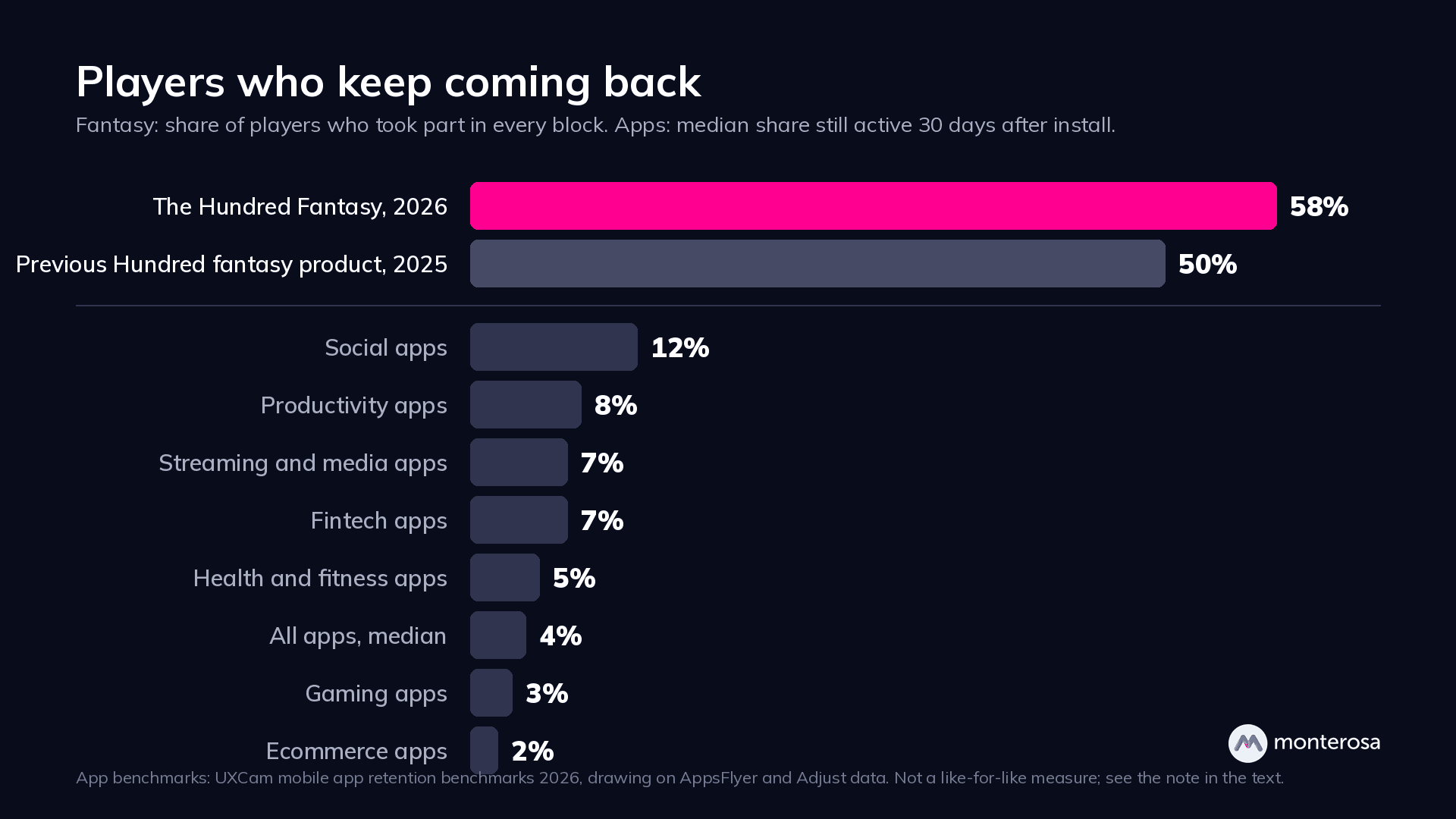
This summer, 58% of The Hundred Fantasy players participated in every playable block of the tournament: 10x what typical apps achieve in retention. What can that tell us about creating products people repeatedly choose to return to?
58% of players participated in every playable block, up from 50% with the previous product.
This summer, Monterosa re-entered the fantasy sports market with a new Fantasy solution for the England and Wales Cricket Board.
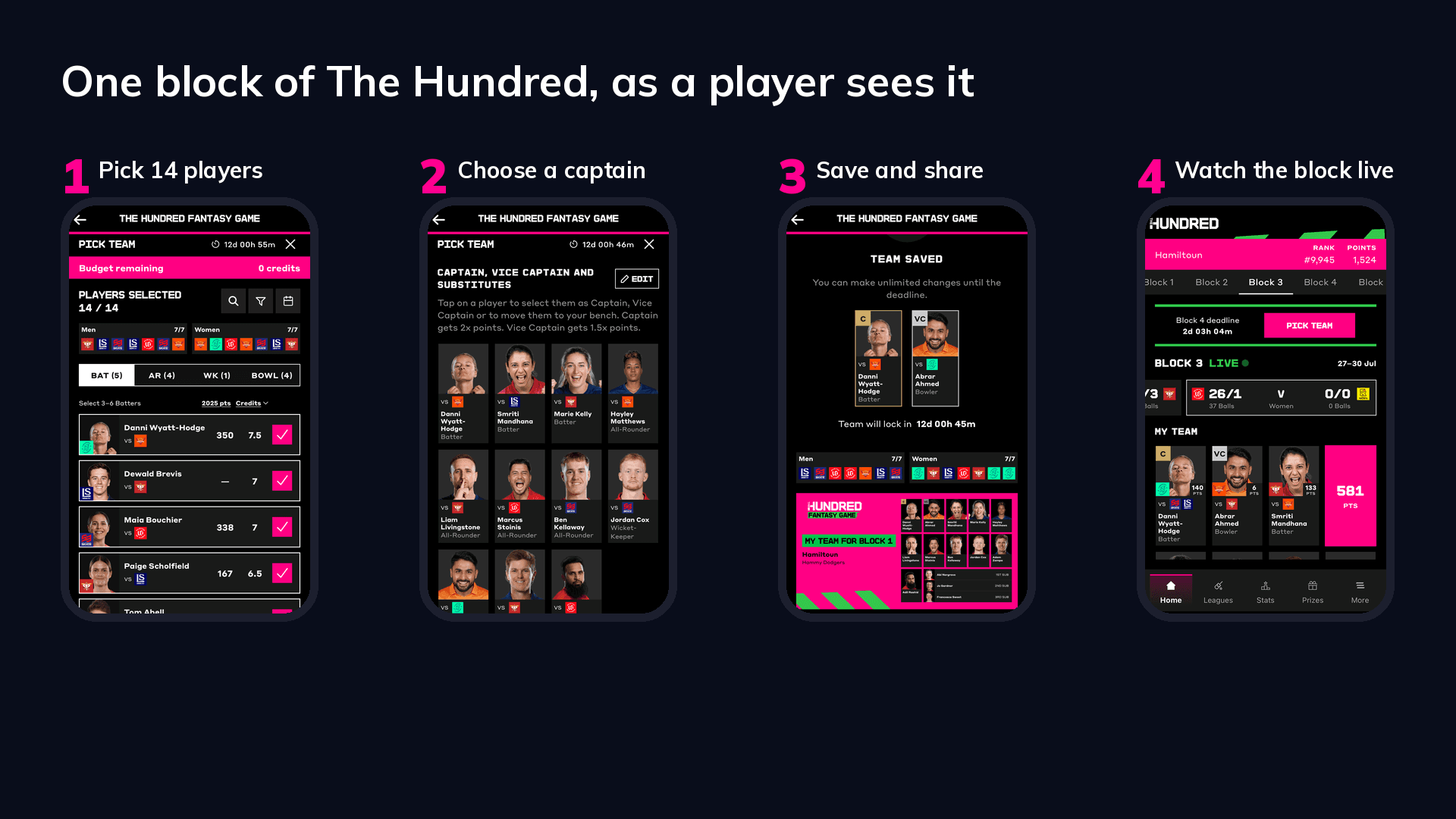
Our first launch was for The Hundred, the ECB’s annual 100-ball cricket competition. The brief was to build on the previous fantasy format by bringing the men’s and women’s competitions together, incorporating live data and creating a more mobile-focused experience.
One of the central goals was straightforward: encourage players to keep coming back throughout the tournament. It’s well known that fantasy engagement can wane.
The results were encouraging.
58% of players participated in every playable block of the competition, compared with 50% under the previous product.
That is an eight-percentage-point improvement, equivalent to a 16% relative increase.
It is a result worth celebrating but it also raises a wider question.
Why are fantasy games more effective at sustaining participation than other products, and what can other direct-to-consumer products learn from them?
First, a word about retention
Comparing The Hundred’s 58% figure with conventional mobile app benchmarks is helpful but could also be a stretch.
Across many app categories, Day-30 retention is often in the single digits. Mobile games, media apps, retail products and other consumer services regularly lose a large proportion of their initial users within their first month.
But this is not quite a like-for-like comparison.
Day-30 retention typically measures whether someone who installed or used an app at the beginning of a period returns on or around a particular later day.
The Hundred figure measures something different: the proportion of fantasy players who participated in every block of a finite sporting competition.
Arguably it is better understood as a measure of continuous tournament participation.
We should be careful about claiming that fantasy retains users ten times better than another category. The methodologies, audiences and products are different.
But the wider comparison is still useful.
Most digital products find it difficult to create compelling reasons for users to return repeatedly. The Hundred Fantasy persuaded more than half of its players to participate at every stage.
The interesting question is why.
Fantasy starts with an advantage
Fantasy products do not begin with an indifferent audience - they are built around something people already care about.
The players, fixtures, rivalries and results already matter to the audience. The game does not have to manufacture interest from scratch. Instead, it gives that existing interest a new form of expression. Sport tends to supply a reliable sequence of talkable moments.
Another fixture coming, another team selection to make… another player’s form to assess or a result that could change the rankings. This creates a natural rhythm of anticipation, action and consequence.
Many consumer products have to invent reasons for people to return. Fantasy games inherit them from the sporting calendar.
That is a major advantage, but it does not fully explain the outcome.
The previous version of The Hundred Fantasy was connected to the same competition and the same underlying audience passion. Yet the new product increased full-tournament participation from 50% to 58%.
That suggests passion alone is not the only driver.
Passion creates the opportunity. Design converts it into behaviour.
Fantasy works because it turns passive interest into active participation.
A fan is no longer only watching what happens. They have made decisions that will be affected by what happens.
They have selected players. Used transfers. Joined a league. Compared their judgement with friends, family or other supporters.
Each real-world development now carries a personal consequence.
That creates several powerful reasons to return:
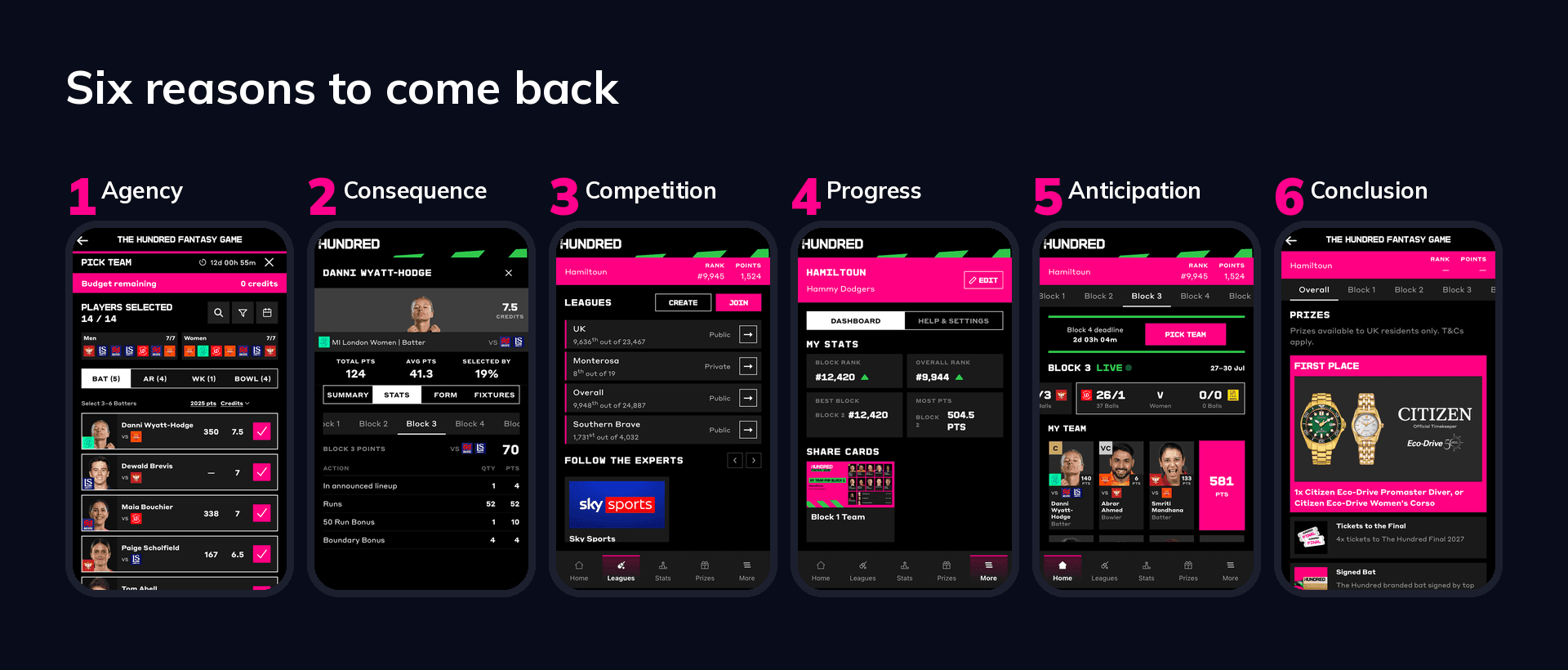
Agency: Players make choices rather than simply consuming content.
Consequence: Real-world events affect their own results and rankings.
Competition: Performance is measured against other people.
Progress: Scores and league positions develop over time.
Anticipation: Each new block presents another decision or opportunity.
Conclusion: The game has a clear end point, with winners and losers.
The design of The Hundred Fantasy also suited the nature of the competition.
The tournament was divided into manageable playable blocks. Players had enough flexibility to change their teams. The competition was long enough for decisions to matter, but short enough to maintain momentum.
These details matter.
A game can be attached to an exciting sporting event and still lose people if it becomes too complicated, too punishing or too difficult to rejoin after a missed moment.
Good fantasy design maintains consequence without making participation feel like work.
The lesson for other D2C products
The conclusion is not that every consumer product should launch a fantasy game.
Nor is it that adding points, badges or a leaderboard will automatically create loyalty.
The more transferable lesson is that repeat participation becomes easier when a product connects these things:
A moment people already care about.
A meaningful choice.
A consequence that unfolds over time.
Visible progress or comparison.
A reason to return for the next stage.
Ways to remind, nudge and notify.
Sport naturally contains these ingredients, but it does not have exclusivity on them.
A streaming service could build recurring play around a live series, major release, awards season or reality competition.
A retailer can create participation around product drops, collections or seasonal events.
A food delivery service might build a shared challenge around major sporting occasions, cultural moments or local discovery.
A fitness product can turn real-world events into team challenges, streaks and competitive seasons.
The opportunity is not simply to “gamify” the product.
It is to identify moments when customers already feel anticipation, identity, uncertainty or a desire to compare themselves with others, then create an experience that gives those feelings somewhere to go.